
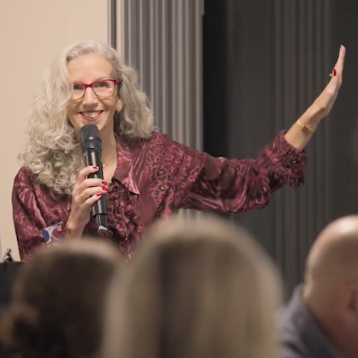



Speaking & Events
Consistently well-rated. Highly professional.
As an event organiser, you’ll have a lot to consider. Events require careful planning and they are a significant investment in your people. I’m here to help you make the most of your event, to give the audience an experience and practical knowledge that will stay with them, long after the occasion. My content is research-informed, highly practical and delivered with heart (with a good measure of appropriate humour in the mix). My style is grounded in lived-experience and uses rich storytelling.
I specialise in speaking about suicide, seeking to change how people understand, navigate and support suicide loss.
Research-informed, highly-practical, and delivered with heart.
The topics I speak on, particularly around suicide loss and grief, resonate deeply with audiences because they touch on what we know of basic human needs; to feel safe, seen and heard, and to survive. When suicide happens, the impact is profound. Loss, grief and disruption can challenge us at our core. I speak directly into this reality, using rich story telling, wrapped in appropriate humour and heart. Yet the real ‘gold’ I bring to the stage is my ability to share tangible, practical tools that people can start using, immediately, at home and work. My message lands because it resonates deeply, and personally. I speak to people’s hearts and minds, to their lived experiences, offering useful tools to help them cope, and a sense of hope that they will get through what they are navigating.
As a speaker I seek to give each individual in the audience an experience. I don’t speak to them; I engage with them. That’s where the magic happens.
The power of resonance
Looking for a speaker the audience will thank you for booking?
Let’s talk.
“Articulate, informative and highly practical. This session was a real game-changer for me. Thank you!”“Just amazing - research knowledge, practical, passionate, authentic. No nodding off with Shelley! Thank you, that will stay with me.”“The information was invaluable, the authentic delivery with passion and no apology was amazing”“I could have listened to Shelley all day. She challenged what I thought I knew, yet did so with such gentleness and grace. Everyone needs to hear this”Keynotes
I will work closely with you to understand your specific context and needs, and customise my keynote accordingly. No two keynotes are the same. Different aspects of content are weaved together to meet the objectives and needs of your event. I draw on the science of grief theory, agency and support, combined with powerful storytelling and over 20 years of suicide grief support and speaking experience. Much of my work focuses on understanding, navigating and supporting
If you have a bespoke topic you’d like covered, the researcher in me is always up for the challenge. Get in touch to discuss what you have in mind.
KEYNOTE TOPIC #1
After Suicide: Supporting People Their Way
Most people know someone who has experienced or been impacted by suicide loss. Yet those who experience suicide loss often receive less support, or are supported for a shorter period of time, than those grieving other forms of loss. The stigma and taboo around suicide and not knowing what to say or do, gets in the way of people showing up and offering the support that is needed. This keynote seeks to change that; offering understanding and practical ways to support people after suicide.
Drawing on two decades of research and suicide-loss support and education, I share research-informed, practical tools on how to support people bereaved by suicide, their way. That is, in a way they can experience as helpful.
Takeaways from this keynote:
Understand suicide, what it is and what it’s not,and why support after suicide matters
Learn how agency plays a central role in supporting others in their grief.
Gain practical research-informed tools and language to support others following a suicide, their way.
Improve the quality and responsiveness of care and connection offered to those navigating suicide loss.
KEYNOTE TOPIC #2
Grief at Work After Suicide: Supporting People Their Way
When a suicide has occurred, grief doesn’t stay at home. It comes to work. When unsupported at work, grief results in increased absenteeism, presenteeism and turnover. This keynote will equip leaders and teams with the understanding, skills and language to acknowledge and better support colleagues in their suicide grief, creating a culture of care.
While the case for support is clear, we live in a largely suicide and grief illiterate world. None of us learn how to support others at school and it’s not covered in leadership programmes. When those we work with are grieving, it can be tricky to know if and how to offer support. Most people want to acknowledge what has happened, yet are often unsure how to respond, so they don’t say anything.
The bereaved are left feeling unsupported, often hiding or silencing their grief at work. Colleagues feel awkward and unsure. No one wins. This keynote seeks to take the awkwardness and guesswork out of supporting grieving colleagues.
Drawing on two decades of research and grief support, I share research-informed, practical tools on how to support others, their way.
Takeaways from this keynote:
Understand the cost of unsupported grief at work, and how each of us plays a role in supporting those who are struggling.
Learn how agency plays a central role in supporting others in their grief.
Gain practical, research-informed ways and language to support others at work.
Contribute to a culture of care and psychological safety, improving how individuals and teams are supported in their grief at work.
KEYNOTE TOPIC #3
From Invisibility to Mattering: Rethinking How We Support Children After Suicide
Children are often referred to as the “forgotten mourners”. Not because parents, teachers and counsellors don’t care (they do), but because many parents and professionals report feeling ill-equipped to know how to best support grieving children. Based on my research with grieving children, this keynote offers a new approach to support; a mattering-reinforcing approach. Learn how to support children affected by suicide, their way, with care responsive to their actual rather than assumed needs.
Based on the voices of children I interviewed as part of my PhD research into the care and support experiences of 6–13 year olds following suicide loss, this keynote challenges how grieving children are viewed and supported.
Warm, moving and highly practical, this keynote challenges current thinking and approaches to supporting grieving children, offering a new, mattering-reinforcing approach. It elevates the voices of children and what they need us to know about how they need to experience care and support when they are grieving.
Takeaways from this keynote:
Rethink assumptions about grieving children and their support needs
Understand the role of mattering in supporting grieving children, so care and support can be based on their actual rather than assumed needs.
Feel better equipped to support children, their way, with support led by them.
KEYNOTE TOPIC #4
Conversations That Save Lives: Supporting People At Risk of Suicide
Most people want to support someone who is struggling. They notice changes, feel concerned, and wonder whether they should say something. Yet uncertainty about what to say, fear of getting it wrong, or worry about making things worse often gets in the way.
So people hesitate. Or stay silent.
This keynote seeks to change that.
Drawing on research and over 20 years of experience in suicide grief support, I share practical, grounded ways to recognise when someone may be struggling, and how to respond in ways that feel safe, human, and helpful.
At its core, this keynote is about building confidence to have real conversations when it matters most, grounded in care, curiosity, and connection. It also provides a clear, practical structure for how to respond when someone may be at risk.
The audience will leave having learned a simple 4-step framework (the 4 A’s):
Awareness - knowing how to recognise when someone may be struggling
Ask - using clear, direct language to determine if the person is at risk
Act - connecting the person to appropriate support
Aftercare - attending to your own needs, and continuing to support the person, as appropriate.
We can’t always prevent suicide.
But we can create environments where people feel more able to speak, and more supported when they do.
Rethinking care and support for grieving children
Recognised as a global authority on children’s postvention and grief support, I invite you to watch my TEDx talk (Bearing in mind that I bring a different type of energy to my speaking, depending on the topic!). Here I share the findings of my PhD research that lead me to develop the approach, mattering-reinforcing care.